Living Apart, Together
A Conversation with Nicholas Gilliland,
Igo Kommers Wender, and Karen Kubey
December 2025
Apartments occupy a paradoxical position in the built environment. They are spaces of separation—defined by walls, codes, and legal boundaries—yet they depend on shared architecture, infrastructure, and circulation. Within this condition, questions of privacy and adjacency are not abstract concerns but everyday realities.
As development patterns and environmental pressures bring more people into apartment living, these buildings increasingly register the conditions of contemporary life. Changing family structures, new modes of work, aging populations, and material and regulatory limits intersect with the ways apartments are designed, managed, and inhabited. The apartment thus emerges not only as a housing type, but as a site where ways of living negotiate ways of building.
In this roundtable, AWW editors Mai Okimoto and Sebastián López Cardozo convene Nicholas Gilliland, Igo Kommers Wender, and Karen Kubey to reflect on apartments across practice, policy, and lived experience. Moving between theory and example, the discussion considers how architecture might support—and balance—privacy and sharing at multiple scales. This roundtable has been edited for length and clarity.
Mai Okimoto (MO): I’d like to begin by asking how apartments and multifamily housing have figured into your professional practice. And perhaps you can also tell us the scale at which you’ve been thinking about apartments—whether at the level of the neighborhood, the lot, or the unit itself.
Karen Kubey (KK): Most of my career has taken place in New York, where the bulk of housing is multifamily. I started my career at a firm where much of the work involved designing affordable apartments (“affordable” in this case meaning privately developed and operated, funded through tax credits, and income-restricted).
I noticed how many decisions are made before a project ever reaches an architect. It could be frustrating, seeing what was left for us to shape. Since then, I have been working upstream on questions of how we think about affordable housing and the role of architecture in housing justice.
Igo Kommers Wender (IKW): In my practice, I have repeatedly returned to multifamily housing as a lens for broader cultural, political, and economic structures—how regulation, finance, migration, and domestic labor take form in the spaces we live and share. For instance, in issue 50 of PLOT, we considered collective housing as a way to redefine the limits of domesticity—beginning with the intuition that the ecological crisis, growing inequality, and the so-called sharing economy were already challenging our ideas of ownership and privacy, and the concept of home itself.
Norms surrounding family, love, work, and aging have shifted radically, while most of the spaces we inhabit still follow postwar scripts: the traditional nuclear family, linear work-life trajectories, and conventional notions of ownership…And so apartments become evidence of a misalignment between how we live and where we live—but they’re also potential sites for resetting that relationship.
Nicholas Gilliland (NG): From our office’s launch in 2011, housing has been central to our work. Very early on, we had the opportunity to work on a collaborative mixed-use project that combined market-rate housing, intermediate-rate housing, and affordable housing—with three different housing authorities—as well as a cinema and a community building in the same development. That level of mixed use in Paris was fairly rare, and it informed our thinking about density, extreme proximity, and the opportunities that come with them. It raised questions about the commons, about equality, and about how housing interacts with and contributes to the city. We saw that density requires a continuous negotiation of both space and use, a certain flexibility, notably in the thickness of its edges.
Since then, the rethinking of these in-between spaces—and of the collective thresholds that lead from street to front door—has become a central concern. These intermediate zones now serve as critical sites for experimenting with how we might ‘live together separately.’
Sebastián López Cardozo (SLC): In apartments, people live close together—sometimes by choice, sometimes not. Is privacy different within (for example) a family than it is between people who don’t know each other?
KK: In an apartment, the bedroom is usually the most private space—but they can take on different roles depending on how people live.
I recently spoke with a musician based in New York, who is also a single dad. He lives in an apartment with three bedrooms—one for himself, one for his young child, and one that serves as his music studio. He’s struggling to stay housed; he needs funding to remain where he is. But the assumption embedded in many housing laws is that three bedrooms for his household constitutes “over-housing.” In his case, it absolutely isn’t—it’s what he needs in order to work and live.
The idea of working in one’s home, especially in apartments, is not new—there was piecemeal work happening in tenements more than a century ago. I’m curious about how we can produce housing that actually works for how people are living and working today.
NG: You’re also seeing profound shifts in family structures and how people imagine domestic life… How do you design with the evolution of needs in mind—creating conditions that accommodate unexpected uses and open future possibilities…?
IKW: Problems around living arrangements, care, and aging are always particular and difficult to generalize. I often think about my own situation: I’m single, I don’t have kids, and I wonder what aging will look like for me. Will I live with friends and share a house, taking care of one another? I believe this is a reality for many people today: how they will live as they grow older.
There’s an example that feels relevant—the “three-generation house” by BETA Office in Amsterdam. It’s a very small project of 450 square meters distributed in five floors—two apartments and an office—built for an adult couple, their children, and their parents. The project includes a workspace on the ground floor so that the younger adults can work while the grandparents help take care of the children.
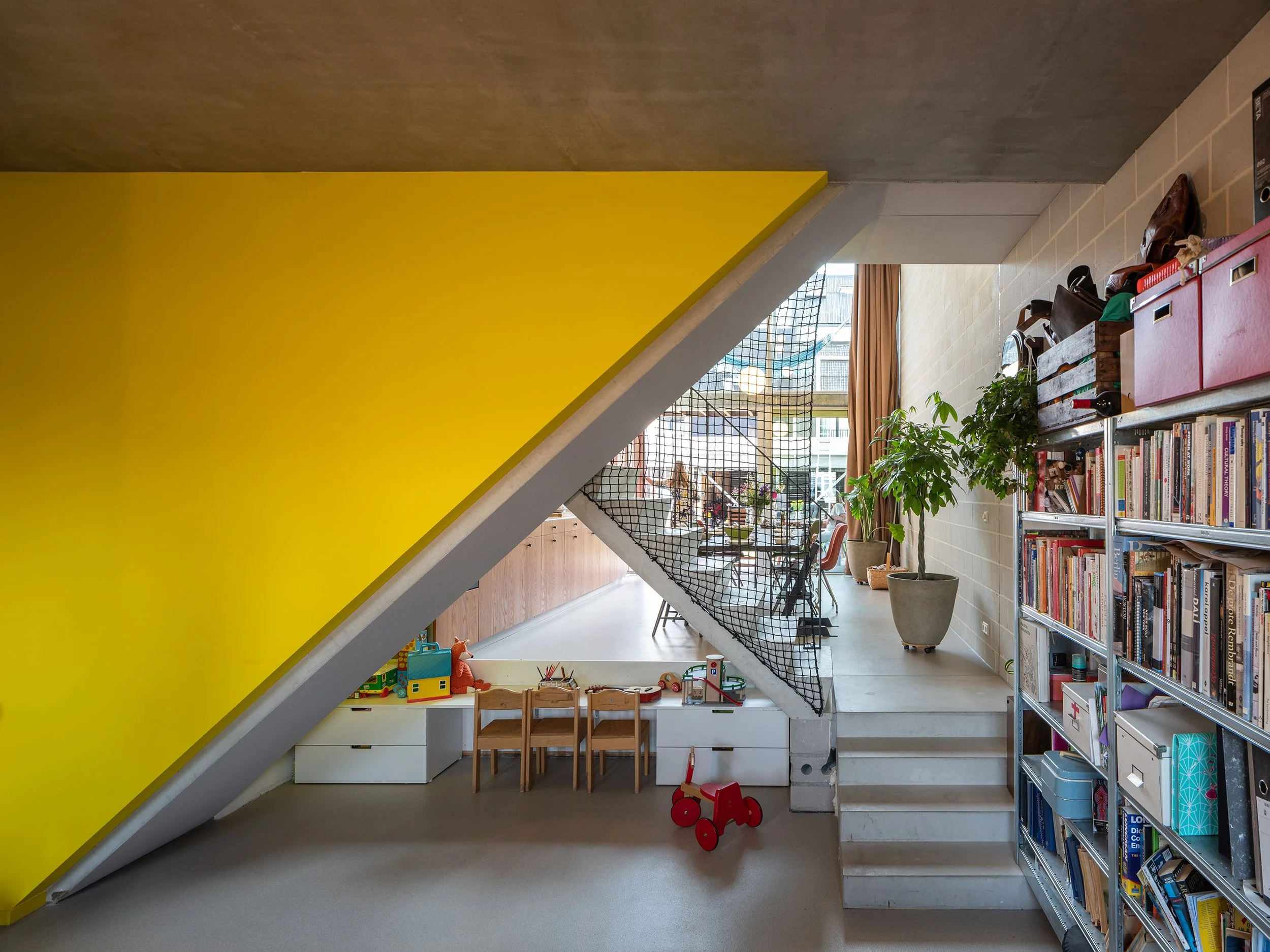
Three Generation House (2018) by BETA Office for Architecture and the City. Amsterdam, Netherlands. Courtesy of BETA Office for Architecture and the City. Photo by Ossip van Duivenbode.
What I find especially interesting about this project is that the core of the house, the stair—usually something enclosed, something that separates one dwelling from another—is open. You still have the apartments with their appropriate levels of intimacy and privacy, but the stair, which would normally divide the units, is the element that brings them together. It stitches the household into a shared environment. I think this is a beautiful way to approach these questions.
SLC: That’s all happening inside the shared space of the home. What about once you step outside of that?
NG: Where I see the most discussion around this is in the building’s collective spaces—the stairs, landings, courtyards, green spaces, corridors, arcades… It’s interesting to compare with today’s standard developer plan, where everything is designed for maximum efficiency—minimizing corridors down to the smallest percentage possible, five to seven percent of gross floor area. Everything is about designing out inefficiencies.
And if you look back at earlier precedents—for example, Henri Sauvage’s collective housing from the 1920s—the landings and collective spaces made up something like a quarter of the building. There was an intentional idea that you might meet your neighbor on the fifth-floor landing between two apartments. I think we may be returning to some of those ideas—a looser fit in collective spaces. And that opens the door to thinking about circulation not as purely functional but as having potential for other uses.
KK: The generous collective space in older buildings reminds me of a recent conversation with a Canadian developer working on supportive housing for people with different health needs... He was talking about incorporating 30% non-leasable, or collective space…
The evolution of collective spaces is so fascinating! I recently wrote about the first limited-equity co-op in New York—the Amalgamated Housing Cooperative from 1927, created by the Amalgamated Clothing Workers Union. They had an array of community facilities run by the tenant-owners themselves: a nursery, a kindergarten, a library, and so on.
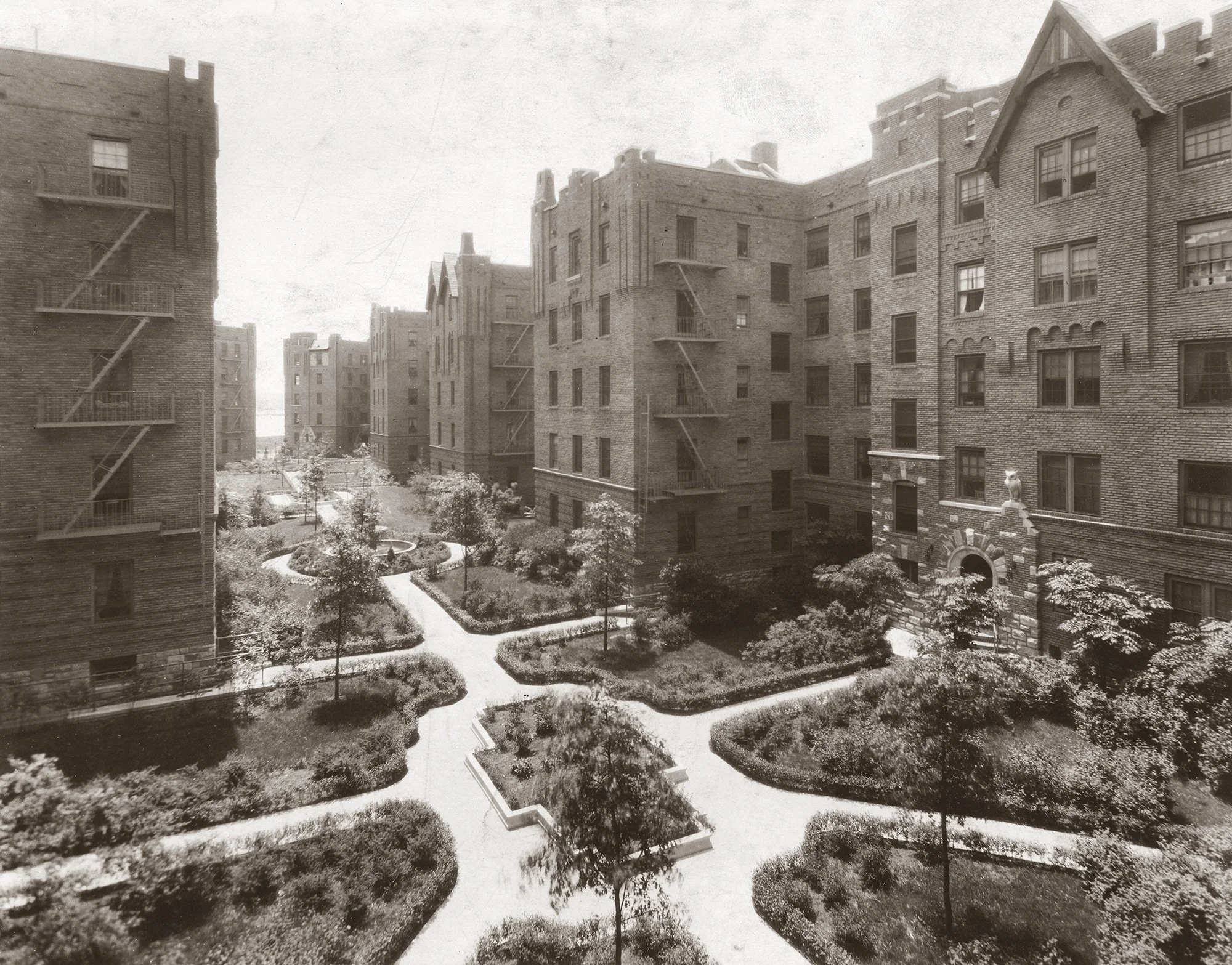
The Amalgamated Houses Building Number 1 (1927) by Springsteen and Goldhammer. Bronx, New York. Photograph taken 1929. Courtesy of Amalgamated Housing Corporation.
If you compare that with what you see today in New York’s newer, luxury apartment buildings— you still find shared spaces, but they’re no longer operated collectively. And there is a pattern: the amenities are designed to command the highest dollar.
Via 57 West is one example. This is a building that has a percentage of affordable or income-restricted units, and collective spaces that look very nice. But you actually have to pay extra to use them. That means that lower-income tenants can’t access the very spaces that might support the community. Too often, even when spaces are designed beautifully, the way they’re operated undermines their potential. I think this intersection between architecture and operations is really important.
IKW: The fact that you have to pay to use the shared spaces—that’s essentially a way of excluding people. It creates a limit right away. For practitioners, this raises a challenge: how to negotiate privacy, or levels of access, within a building. It’s not only about what you think as a designer, but also about the developer’s expectations—and sometimes what “living together” means is very different.
I also think a lot about the conditions under which we might be willing to give up privacy—because when you do it, you’re also redefining what you understand “home” to be. What forms of shared life can be considered a positive choice rather than a sacrifice? That’s important. Sometimes it seems like we only share because we don’t have enough resources to have our own spaces.
Maybe the question isn’t only how we protect ourselves from the neighbor we didn’t choose. It’s also: under what spatial conditions can we decide how much of our lives we want, or are able, to share? For me, that’s the hardest question to answer.
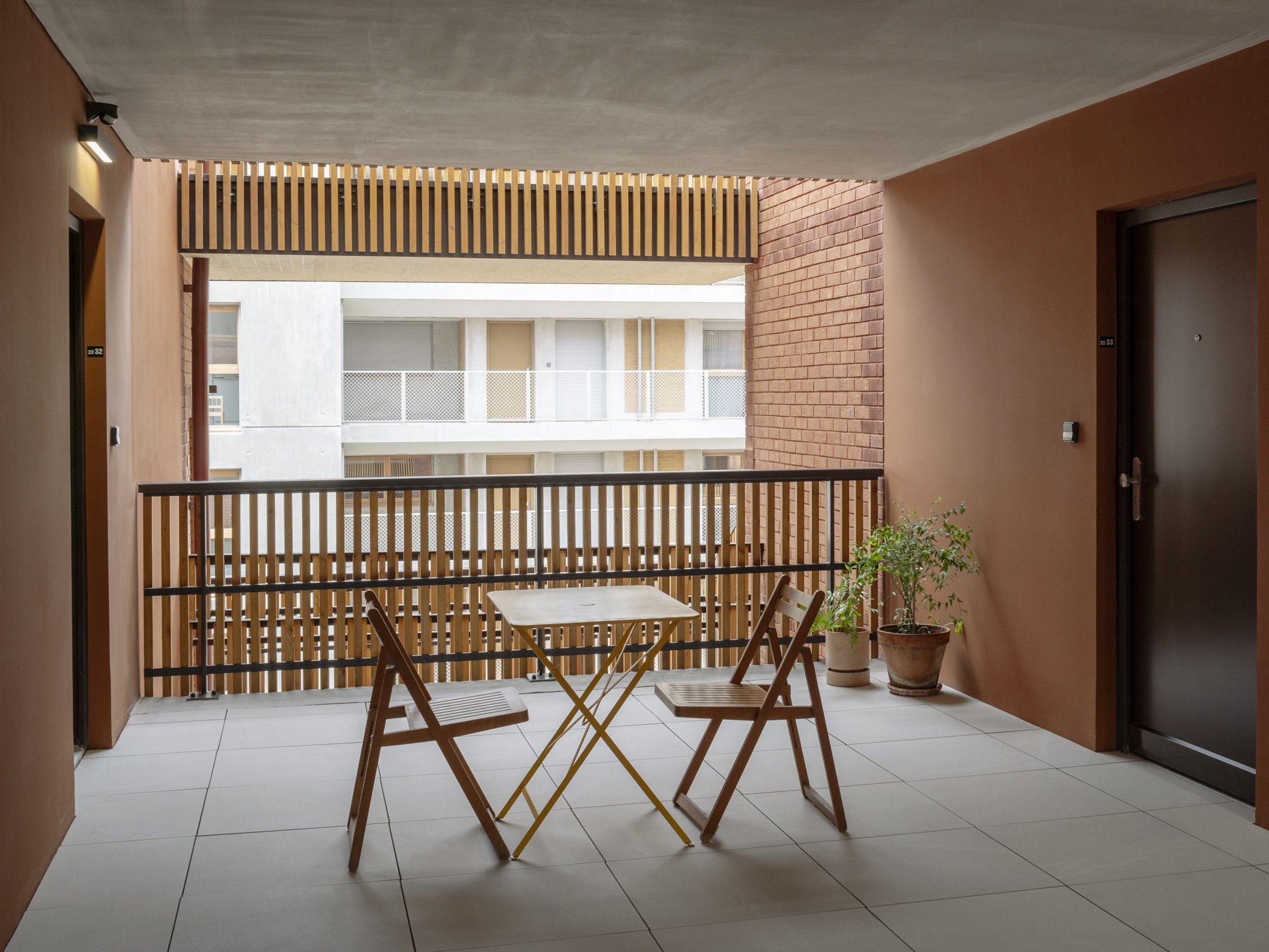
The Bagneux Affordable Housing Project (2024) by Tolila+Gilliland. Bagneux, France. Courtesy of Tolila+Gilliland. Photo by Cyrille Weiner.
In the project, corridors are banished, replaced by an exterior landing on each floor. Serving an average of two to four apartments per floor and measuring a generous 17m² / 170ft², ample for potential appropriation.
NG: One of the questions that often comes up in my practice is around the different scales of sharing. We try to think about how to break down, for example, a 100-unit building into smaller social groupings. In France, the quality of social housing is sometimes measured by how many doors open onto a single landing. Some cities require a maximum of four doors per landing—that means you need more circulation cores, but it also creates moments to meet your neighbors. You can choose to interact or not, but the structure of the building creates conditions where that interaction is at least possible.
There are also larger collective elements—something like a shared garden at the ground level, where residents can participate in gardening (if they choose). But I think what’s interesting, and where I agree with what’s been said, is that amenities often get framed as “programming” and they’re not always truly available to everyone.
What I find compelling are the unprogrammed aspects—the ones that come simply from how we script the building as architects. At the scale of everyday movement through the building, residents can opt in or out of shared moments. They can choose to appropriate a space or simply pass through it. Sometimes the potential for that is just in the thickness of a landing, or the fact that it faces the exterior and gets natural light—conditions that make someone want to linger.
So it’s not necessarily a programmatic issue. It’s not something that comes from the client as a stated requirement. It’s everything between the programs—the in-between spaces—that hold so much potential.
IKW: Are social housing projects like those by Lacaton & Vassal happening widely in France, or are they more like exemplary cases that show how housing could be?
NG: What’s interesting here is that social housing is where the most innovation happens. These buildings are developed and then managed by public entities for hundreds of years. So they build with long-term quality in mind, and with an interest in keeping residents happy. They’re not building to sell and disappear. Because of that, you can have much deeper conversations, and there’s real space for innovation and research.
SLC: So I think this question keeps coming up—even in relation to what Nicholas was saying about these in-between spaces: How much privacy do we need for ourselves before we step out into the public realm?
IKW: There’s a project you might know called One Shared House, by Anton & Irene and SPACE 10—an interactive (web-based) research project to gather information related to the future of coexistence in cities through an extensive set of questions about the extent to which you would be willing to share or not, and in what ways.
KK: Sharing varies by person, by culture, and by time—there are so many factors. We’re talking about how much you may want to share, but many people don’t have much choice. Some of this sharing might be culturally motivated or based on personal preference, but a lot of it is simply economic necessity.
There’s an ongoing discussion in New York about potentially re-allowing single-room occupancy (SRO) units, or residential hotels. With the massive cost of housing, people are revisiting the fact that the city once had many more SROs—small rooms that were essentially bedrooms with a bit of space, while kitchens and bathrooms were shared collectively. There’s interest in bringing back this type of housing, with some improvements, such as fewer people sharing a bathroom.
We’re also seeing variations of that model through platforms like Common (now out of business) that created structured roommate situations where you leased only your own bedroom. There’s this idea that giving up privacy and shifting more of your life into communal space will make housing cheaper. Sometimes that’s true, but without regulation it often isn’t.
IKW: There are still a few examples of SROs in operation here in Chicago but in precarious conditions. The City’s Department of Housing continues to run an SRO Preservation Initiative, which exists specifically because SRO buildings remain in use.
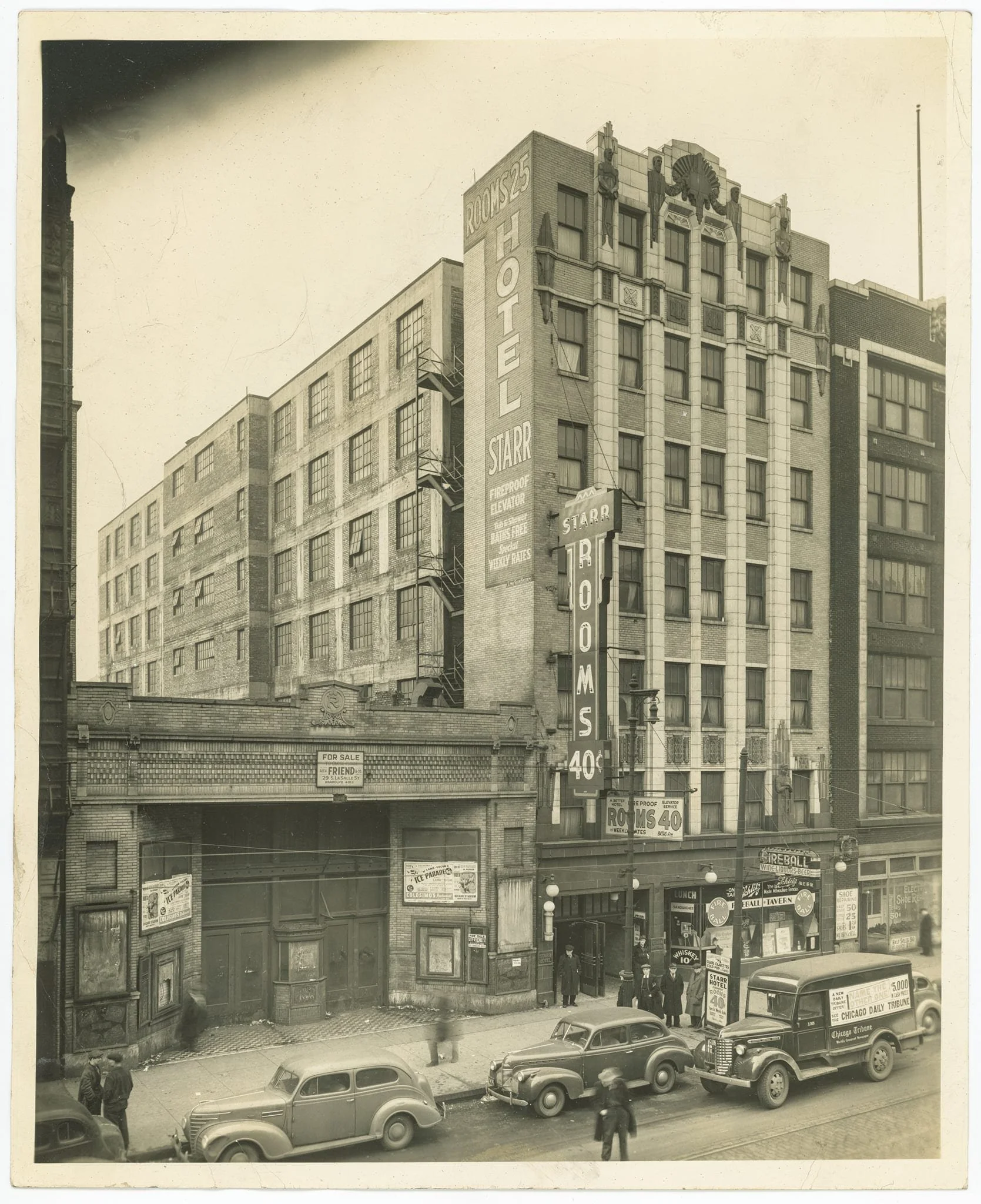
8 x10 photographic print of SRO Starr Hotel, 617 W. Madison Street. Chicago, Illinois. Photograph taken March 1929. Courtesy of BLDG. 51 Museum.
KK: They still exist in New York too, but in much fewer numbers. Many of them were essentially outlawed. A lot weren’t well managed, and rather than address the management issues, the entire typology was restricted or eliminated. There’s a lot of class-based and race-based resistance to these typologies.
NG: Building affordable housing at scale requires substantial political commitment, and there is often significant resistance. It’s one of the most consequential questions for our practice... Even in a city like Paris, some neighborhoods prefer to pay penalties rather than create the required amount of social housing, simply to avoid upsetting their constituency. Ultimately, as with any architectural project, so much depends on the client—on the demands and ambitions of whoever is in charge.
MO: How are apartment buildings changing as our attitudes towards privacy and work styles shift? On the one hand, we have the decisions driven by finance, codes, and efficiency—hard, quantifiable information. And on the other hand, we’ve been talking about the qualitative features of space: the different needs across life stages, the individual needs for privacy, the transition from private to collective spaces. So how do those two sides—the hard and the soft—come together?
KK: It’s very exciting to see what’s happening in Seattle—in 2023, citizens voted to establish Seattle Social Housing, a public development authority. And then in 2025 they voted to fund the authority by taxing corporations—that won by a 26-point margin. The idea of a whole city taking care of itself, and its residents, at that scale is huge. And not only that, they’re going to Passive House standards. These non-market, de-commodified forms of housing—public housing, land trusts, cooperatives—need not stop at policy. They should also be built to the highest design and environmental standards.
NG: I think choosing where to put your ambitions—where you can have the most effect—is crucial in housing. There’s a kind of hierarchy of choices. Lacaton & Vassal came up earlier: they invest everything in exterior space. “Free space”—that’s the greatest luxury.
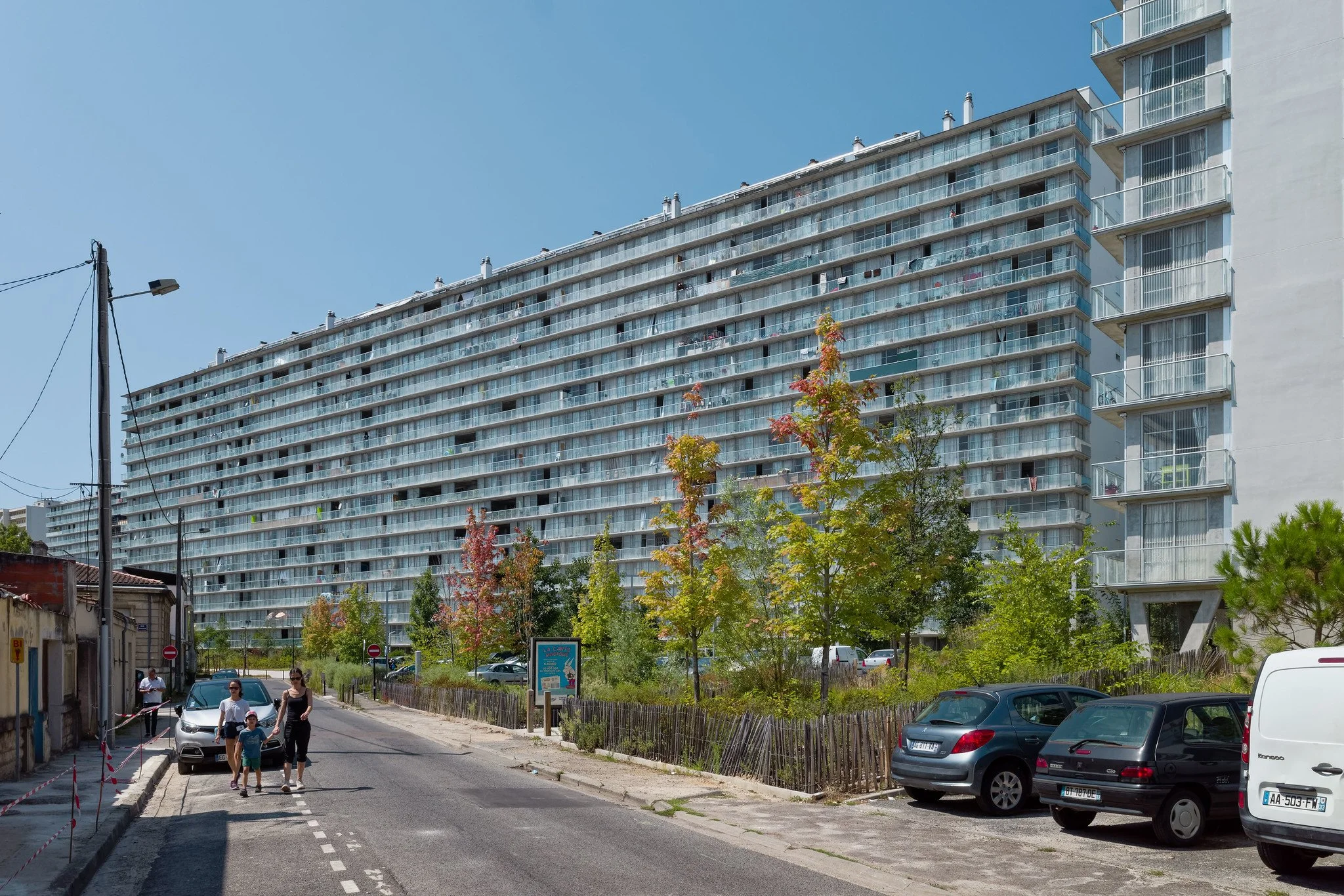
Transformation of 530 dwellings - Grand Parc Bordeaux (2017) by Lacton and Vassal, Fréderic Druot Architecture, and Christophe Hutin Architecture. Bordeaux, France. Photo by victortsu, CC BY-NC 2.0