
Postwar Parquet
Sebastián López Cardozo and Stefan Novakovic
Postwar Parquet_March 2026
Sites of Memory and Transformation
Sebastián López Cardozo and Stefan Novakovic
March 2026
“It's not random white flooring; it has a personality,” Luisa told us, recalling the Toronto post-war apartments she and her father lived in as renters after immigrating from Mexico in the 2000s. She was referring to the oak “finger-block” parquet that lines the floors of many post-war rental apartments across the city. A 2010 report prepared for the Ontario Growth Secretariat found that apartment towers built between 1945 and 1984 comprised 48% of Toronto’s rental housing stock — significant for a city where almost half of all households are renters.
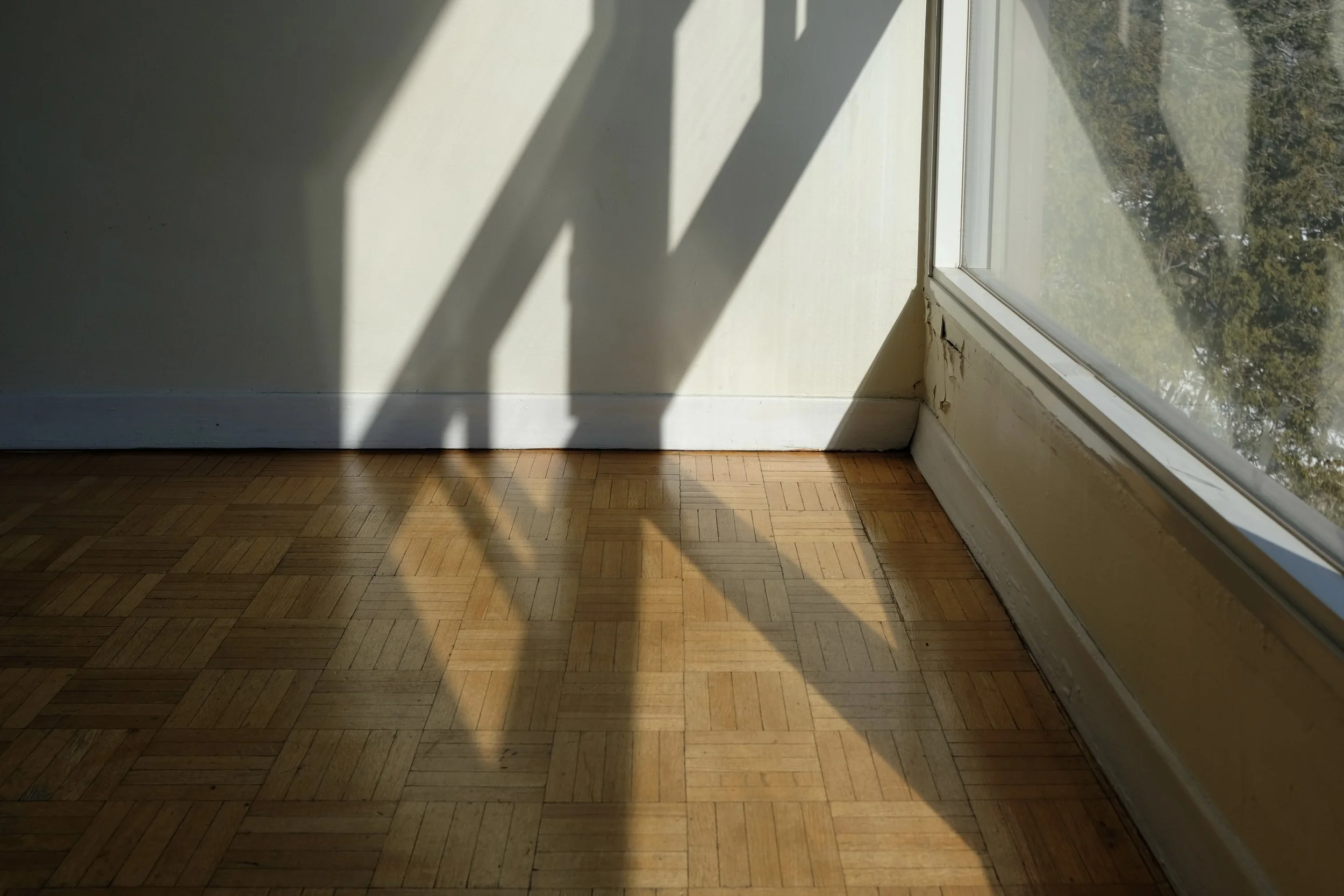
4 ¾” x 4 ¾“ oak “finger-block” parquet in Toronto rental apartment building, 1968. Photo by authors.
While precise numbers are difficult to trace, parquet flooring is ubiquitous in these towers — and by extension, deeply embedded in Toronto’s renter and immigrant experience. The same report notes that these buildings have increasingly housed newcomers and low-income families. Of the 2.5 million immigrants who arrived in Canada after 1985, roughly 43% were living in Toronto by 2001; today, more than half of the city’s residents are foreign-born.
And yet, like the hundreds of towers erected in the decades following the Second World War, parquet flooring has slipped into anonymity. Archival newspapers reveal its former prominence: ads in the Toronto Star throughout the 1960s and 1970s promoted “genuine oak parquet flooring” that “glues down easily to wood or concrete,” while condominium developments listed “hardwood parquet flooring” as a key feature. Even parquet-like linoleum tiles promised a “wood effect.” The pattern proliferated beyond floors — appearing in furniture, television trays, and home décor — suggesting an almost obsessive fascination with its modular geometry.
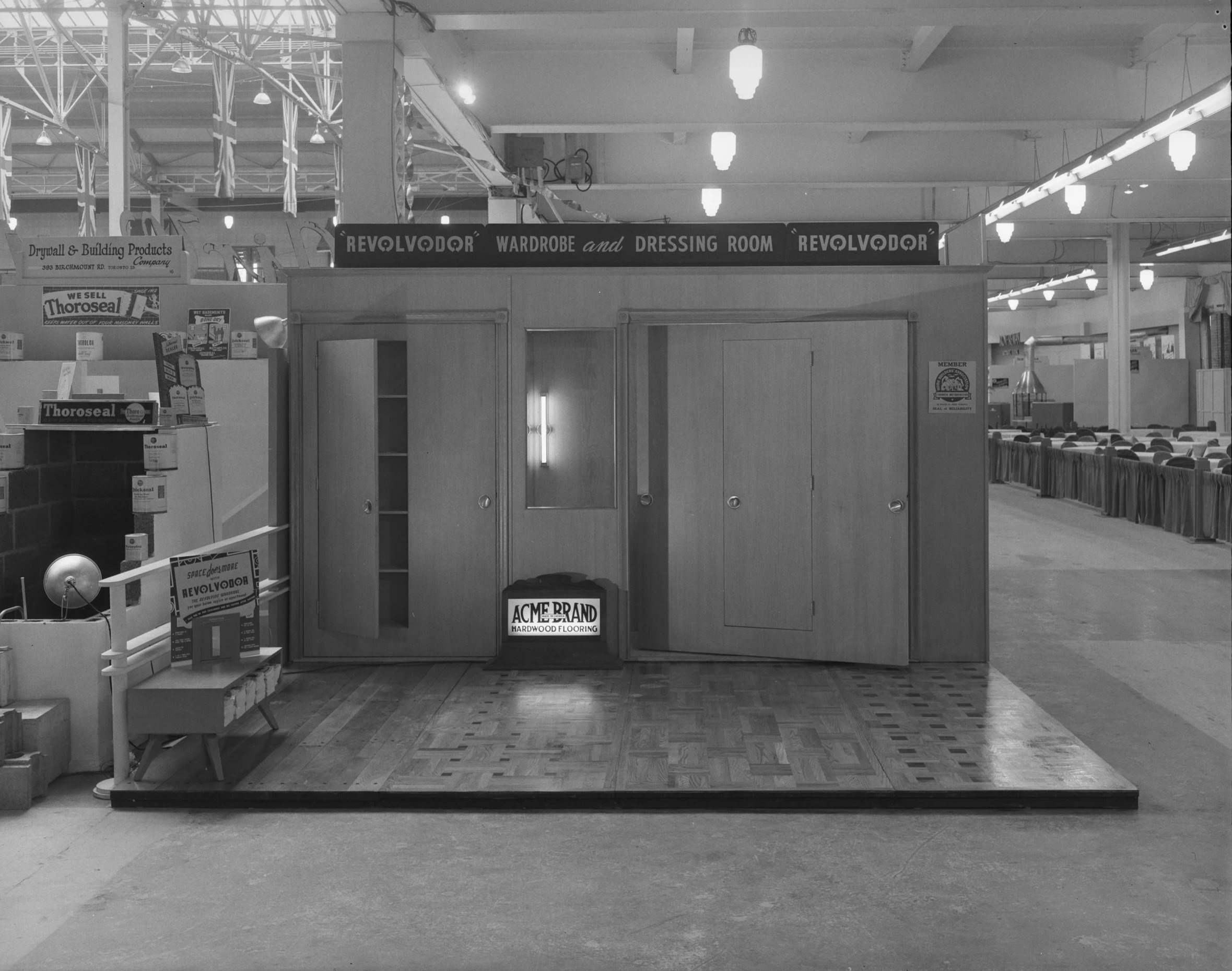
Acme booth at the National Home Show in Toronto, 1953. City of Toronto Archives, Fonds 1653, Series 975, File 1317, Item 20922-2. Photo by Gilbert A. Milne & Co. Ltd.
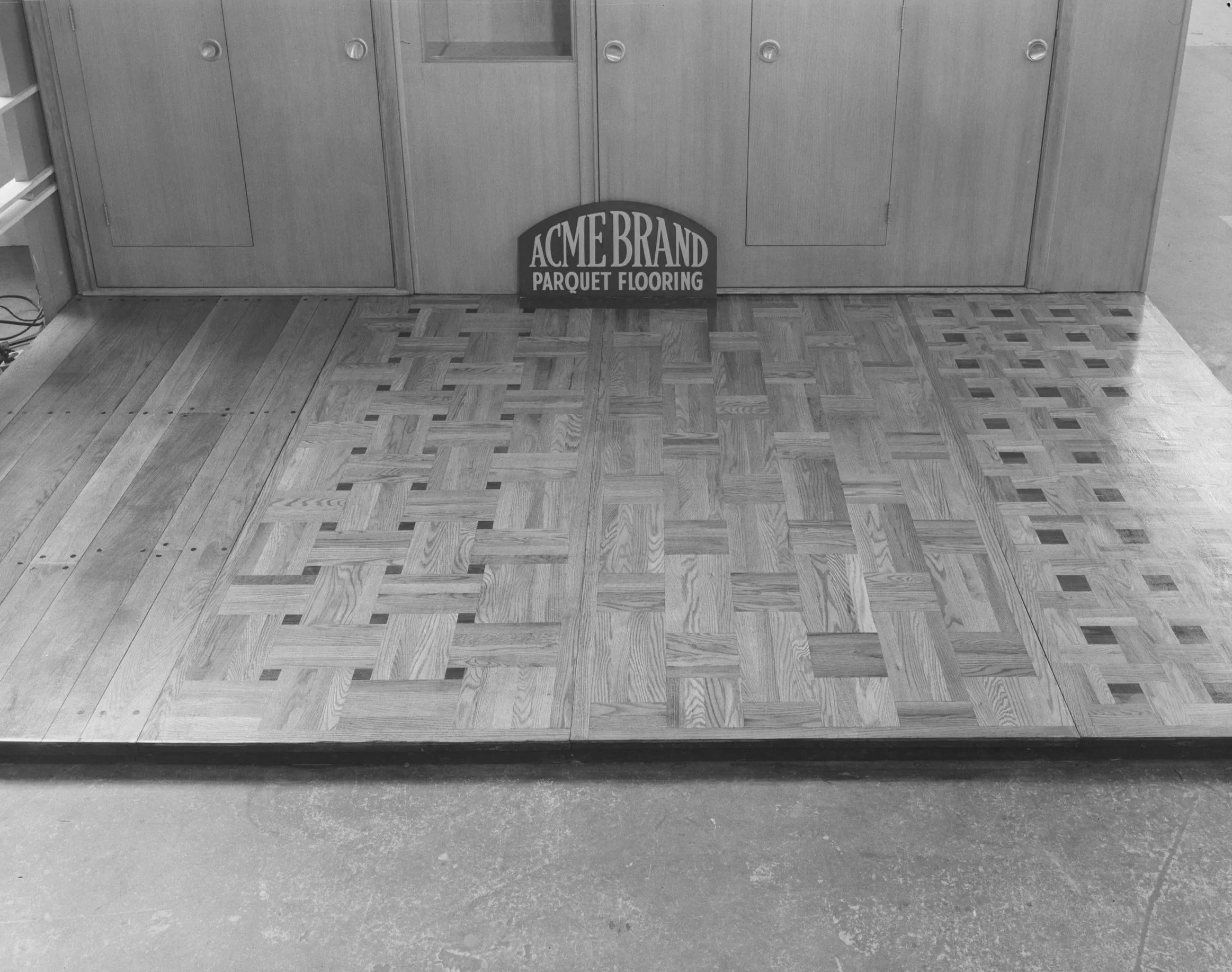
Acme booth at the National Home Show in Toronto, 1953. City of Toronto Archives, Fonds 1653, Series 975, File 1317, Item 20922-1. Photo by Gilbert A. Milne & Co. Ltd.
In many apartment buildings, the original bright orange-blonde oak has been subdued during renovations. Dark stains and polyurethane finishes mute its graphic intensity, pushing it into the background alongside beige walls, stainless steel appliances, and quartz countertops. The parquet floor remains, apologetically.
It also provokes mixed feelings.
A social media call for memories of parquet elicited dozens of responses and sparked in-person conversations. For some, it evoked warmth and urban life; for others, it signified economic constraint.
For Luisa, it was a reminder of her father’s immigrant experience. “I have this idea of [my dad] being stuck there in a financial sense, but also metaphorically, a manifestation of where he feels stuck as an immigrant,” she told us. “I distinctly remember him trying to move out of that apartment to other places in different locations [...] and moving out, then moving back in, then moving out, then moving back in again,” while the building deteriorated. Over the years, Luisa said, her father changed many things in the apartment: He painted the walls, he changed the sofa, he rearranged the furniture. “And it really does change the overall feel of the place, but it’s still like, you can’t change the flooring — right?”
For Edwin, its meaning shifted over time. He grew up with it in the 2000s, and as he got older and met others whose homes looked different from his, he resented what it meant for him: “I started to see parquet flooring as a symbol of poverty.” But that gradually shifted. “I became involved in electoral politics and started canvassing in the neighbourhood where I grew up; I saw parquet flooring everywhere,” he told us. “It showed up in all kinds of homes, across different cultures and family situations; that changed how I saw it.” Instead of a marker of poverty, he began to think of it as something shared — a quiet sign of solidarity with the people who shared his life experience.
For others, like Heather and Alexandra, parquet flooring meant city-living. “When I was a young child, I lived in a suburban house that was mostly carpeted,” Alexandra told us, and associated parquet with city apartments. “Visiting someone who had them [...] I remember trying to walk in all these funny ways to match the pattern of the parquet floors — trying to align my foot with individual panels in each square and then twisting around to move to the next one.” The panels and squares of Alexandra’s childhood memories of the 1990s are likely the oak “finger-block” parquet, typically four, five, sometimes even six or seven, “fingers” making a square and laid out at alternating 90 degrees. A cursory look points to subtle variations in the size of the parquet squares too, most commonly seen at 9” x 9”, 6” x 6”, and 4 ¾” x 4 ¾”, but generally quite varied.
Alexandra’s post-war apartment in the city, currently at risk of demolition, has the 9 x 9”, four “finger” arrangement, with the ubiquitous polyurethane finish. “The big deal in our building is the color of the floor,” she told us. “Some apartments got redone with dark varnish, which means that they lost the blonde, orangey glow.” Over time, she has come to associate parquet flooring with comfort and proximity, “where people live in relaxed, old-school apartments that don’t feel isolated.”
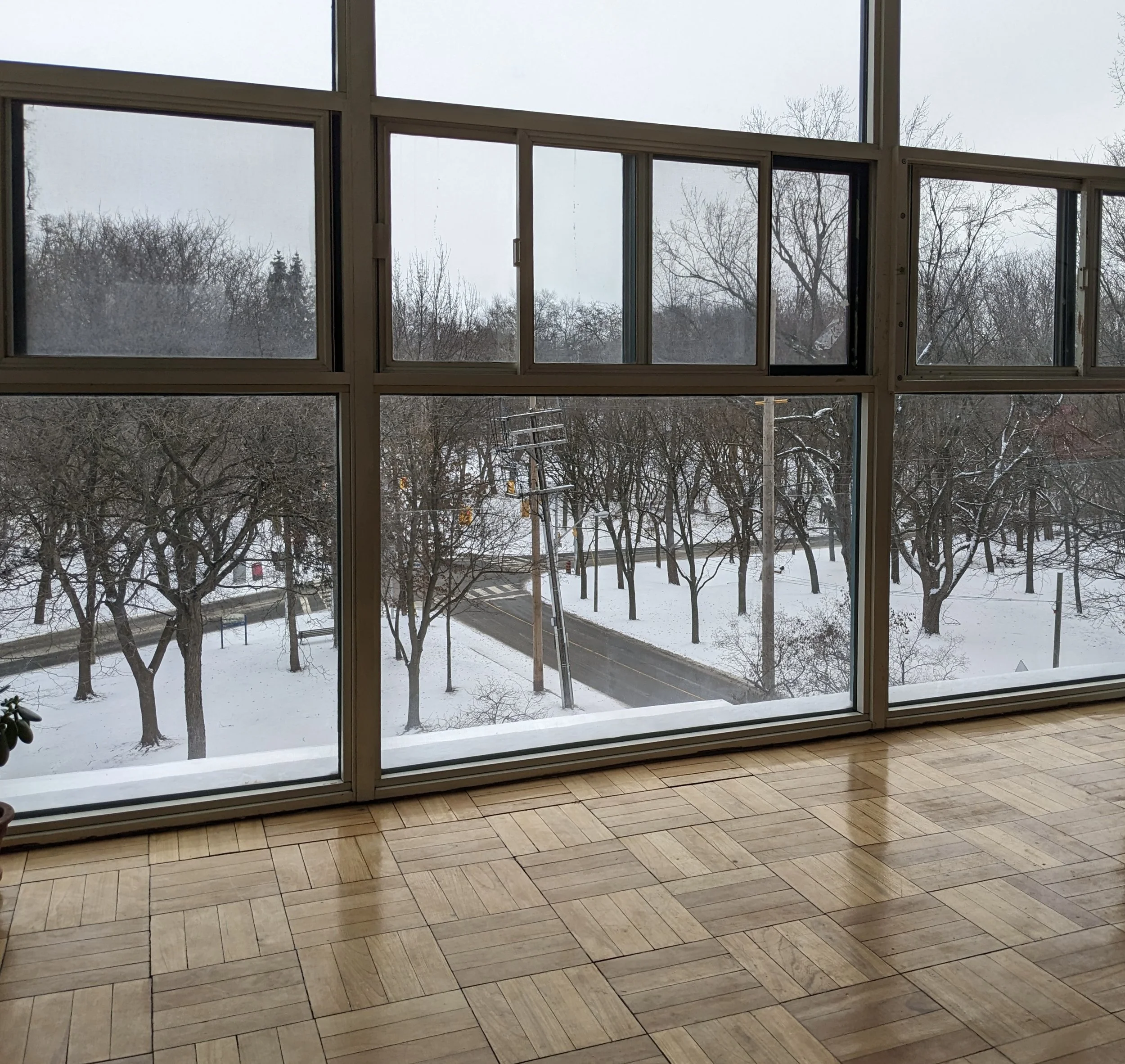
9” x 9“ oak “finger-block” parquet in Alexandra’s Toronto rental apartment building, 1956.